About Dog Training in Islington
Islington is one of inner London's most densely populated boroughs, home to around 245,000 residents and characterised by a housing stock of Victorian terraces and purpose-built flats where private gardens are the exception rather than the rule. Owner-occupation sits well below the London average, with most residents in private or social rented accommodation, which means the majority of Islington's dogs navigate daily life without outdoor space of their own. The borough's demographic leans heavily toward young professionals, creatives and commuters whose working patterns create a particular set of training challenges: dogs that need to be calm when left alone during long office days, manageable on some of London's busiest pavements and reliable enough off-lead to make the most of parks that serve as the primary outdoor space for thousands of households. Add in a strong cafe and pub culture where owners want dogs that can settle quietly at a table, and the case for structured training in Islington makes itself.
Common Behaviour Challenges
The behaviour challenges Islington trainers encounter most consistently reflect the realities of dense urban living. Separation anxiety is among the most frequently cited concerns, particularly as post-lockdown rescue dogs have struggled to adjust to owners returning to full-time office schedules. Lead reactivity is a significant issue on busy roads like Upper Street and Essex Road, where the pace and intensity of street life can quickly overwhelm a dog that has not been gradually desensitised to urban environments. Recall in crowded parks, under-stimulation in flats and puppy socialisation in high-density surroundings round out the most common starting points for training in the borough. Islington's demographic tends toward compact breeds suited to flat life, including French Bulldogs, Cockapoos, Miniature Dachshunds and Whippets, but these breeds bring their own particular challenges around resource guarding, barking and anxiety that benefit from early and consistent training. Rescue dog rehabilitation is also in steady demand, particularly among owners in the denser rental wards who adopted during the pandemic and are now managing dogs with complex behavioural histories.
Popular Training Locations
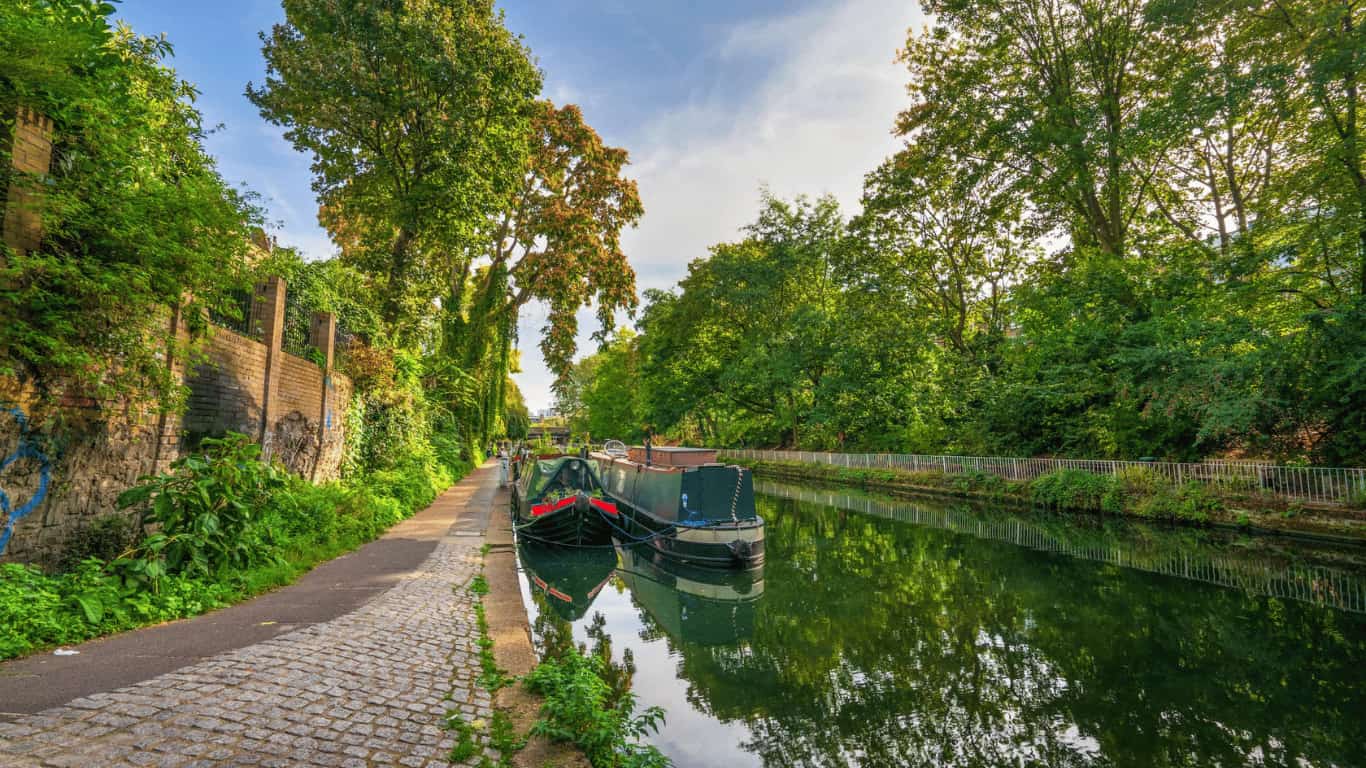
Highbury Fields is Islington's largest and most versatile outdoor training space, at 29 acres with long uninterrupted grass fields that suit long-line recall work and a running track perimeter that provides a reliable distraction environment for heel-work and focus training. It is the park most Islington trainers return to repeatedly, though it is worth noting that dogs are excluded from certain play areas during school hours, with signage at all entry points. Caledonian Park offers a different feel, with a Victorian clock tower, off-lead areas and woodland edges along the canal that provide varied terrain for distraction and focus work. The change of environment alone can be useful for dogs that have become habituated to a single training location. Barnard Park in Barnsbury is a compact, semi-enclosed space that works well for puppy socialisation at earlier stages, with a dog-friendly cafe nearby that enables cafe-settling practice as part of a session. The Regent's Canal towpath runs through the south of the borough and is widely used for on-lead loose-walking and urban desensitisation work, with the understanding that the towpath can be affected by flooding after heavy autumn rain. For reactive dogs or those at the very start of recall training, Islington's smaller square gardens and allotment-adjacent pockets, such as Gibson Square, offer quieter and lower-distraction environments to build foundations before moving to busier spaces.
Local Requirements and Standards
Islington's Public Spaces Protection Order requires the immediate removal of dog faeces in all public areas, with a £100 Fixed Penalty Notice for those who fail to comply, rising to £1,000 if prosecuted. Dogs must be kept on leads in all children's play areas, multi-use games areas, fenced sports areas, formal garden zones and nature conservation areas, and officers can direct owners to put dogs on lead anywhere in the borough if an animal is causing distress or damage. The specific exclusion of dogs from certain Highbury Fields play areas during school hours is a detail worth knowing before planning training sessions around the park. When choosing a trainer, ABTC registration is the most important single credential to check, as it independently verifies that a trainer or behaviourist meets recognised UK professional standards. IMDT membership requires passing practical assessments and a commitment to reward-based methods only, while APDT membership indicates adherence to a long-established code of conduct. A clear commitment to force-free practice, with no use of e-collars, choke chains or prong collars at any point, and a current canine first aid certificate are both worth confirming before sessions begin. Useful questions to ask any prospective trainer include whether they are on the ABTC register and can share their membership number, how they respond if a dog shuts down or reacts badly during a session, and whether they use any punishers or aversive equipment at any stage.
Neighbourhood Insights
Canonbury and Barnsbury tend to attract higher-income owners in Georgian and Victorian terraced homes, often with private gardens and a preference for active or gundog-type breeds. Training demand in these areas frequently focuses on advanced obedience, impulse control and off-lead reliability rather than foundational skills, and owners here are generally willing to invest in experienced, credentialled trainers with a track record in the borough. Highbury generates consistent demand for recall and off-lead socialisation training from the families and professionals who make daily use of Highbury Fields. The park is central to daily life in this part of the borough, and owners who rely on it want dogs that can handle the full range of people, dogs and distractions it presents on a typical weekend morning. The denser wards around Finsbury, Clerkenwell and the Angel concentrate a different profile: first-time owners with flat-dwelling dogs who need practical help with urban walking, puppy life-skills and separation anxiety. Home-visit training is particularly valued across these areas, where working on real-life scenarios in the owner's own flat and on the specific streets they use every day produces faster and more transferable results.
Seasonal Considerations
Summer crowds in Highbury Fields, combined with the Islington Summer Festival and the weekend markets that draw large numbers to Upper Street and the surrounding streets, make recall and neutral behaviour around people and dogs significantly harder to maintain in real-world conditions. Early morning sessions become the practical default for serious training work during the warmer months, and many trainers recommend using the increased footfall as a controlled distraction environment once a dog has a solid enough foundation to handle it. Autumn and winter shift the balance toward home-visit sessions and indoor work. Shorter daylight hours make after-work outdoor training impractical for many commuter households, and the Regent's Canal towpath, one of the borough's most popular training routes, can flood temporarily after heavy rain, requiring rerouting or a move indoors. Demand for in-home behaviour consultations increases through the colder months, and block-booked packages tend to be the most effective way for busy owners to maintain momentum through a period when outdoor sessions become less predictable.
Areas covered: Highbury, Canonbury, Barnsbury, Clerkenwell, Angel, Finsbury, Holloway
Dog Training Prices in Islington
All prices below are approximate and intended as a general guide. Individual trainers set their own rates based on experience, qualifications and the type of session.
Puppy training
- •Puppy consultation (one-off): £145 to £175
- •Puppy course (six sessions, group or 1:1): £145 to £480
One-to-one and adult dog training
- •One-to-one session (per hour): £75 to £120
- •Adult dog training single session: £100 to £110
Training packages
- •Three-session package: £285 to £315
- •Five-session package: £480 to £510
- •Eight-session package: £700 to £780
Prices may vary for specialist behavioural work, in-home training, or intensive programmes.
Each provider sets their own prices, so owners are encouraged to contact trainers directly to confirm availability and exact costs.
How It Works
Find trusted providers in your area in 3 simple steps
Select your borough
Use the dropdown above to filter by your local area
Compare providers
View profiles with ratings and Google reviews
Contact directly
Request quotes or book directly with providers
Dog Training in Other Boroughs
Browse providers across London by borough
Dog Training in Barnet
Browse providers in your area
Dog Training in Bexley
Browse providers in your area
Dog Training in Brent
Browse providers in your area
Dog Training in Camden
Browse providers in your area
Dog Training in Ealing
Browse providers in your area
Dog Training in Greenwich
Browse providers in your area
Dog Training in Hackney
Browse providers in your area
Dog Training in Hammersmith & Fulham
Browse providers in your area
Islington
Current borough
Dog Training in Kensington & Chelsea
Browse providers in your area
Dog Training in Kingston upon Thames
Browse providers in your area
Dog Training in Lambeth
Browse providers in your area
Dog Training in Lewisham
Browse providers in your area
Dog Training in Merton
Browse providers in your area
Dog Training in Richmond upon Thames
Browse providers in your area
Dog Training in Southwark
Browse providers in your area
Dog Training in Sutton
Browse providers in your area
Dog Training in Tower Hamlets
Browse providers in your area
Dog Training in Wandsworth
Browse providers in your area
Dog Training in Westminster
Browse providers in your area
Frequently Asked Questions
Common questions about finding providers in your area
Explore Other Pet Services
Find trusted professionals for all your pet care needs
START YOUR SEARCH
Ready to Find Your Perfect Dog Trainers?
Browse our curated dog training in Islington, all highly rated on Google.
All Dog Training in Islington