 Pawthority
About dog training in Kingston upon Thames
Kingston upon Thames is one of outer south-west London's most family-oriented boroughs, with around 30% of households being families with young children and a settled, financially stable population concentrated in the 40 to 59 age band. Housing is predominantly Victorian and Edwardian semi-detached and detached houses, many with private gardens, particularly across Surbiton, New Malden and the Coombe estate. That owner-occupied, garden-rich profile means dogs are genuinely integrated into family life here rather than squeezed into it, and training demand reflects that: owners are typically looking to produce well-mannered family pets that can handle busy riverside parks, school-run streets and the specific challenges of exercising near deer in two of London's largest Royal Parks. Kingston is also exceptionally well-served with green space, which is both an asset and a complication, because the seasonal restrictions in Bushy Park and Richmond Park create a recurring training challenge that shapes how owners approach off-lead work throughout the year.
Common behaviour challenges
The training needs that come up most consistently in Kingston reflect its family demographic and its proximity to large, stimulating open spaces. Puppy socialisation is a frequent starting point, particularly around introducing a new dog to children, pushchairs and the noise of school-run streets. Adolescent impulse control is the next most common focus, followed closely by recall work, which is a particular challenge near the deer in Bushy Park and Richmond Park where off-lead access is restricted from May to July each year. Lead reactivity on Kingston town centre's busy high street and jumping up on children are among the most commonly cited concerns from family owners. Labradors, Golden Retrievers and Spaniels dominate the breed profile across suburban south-west London, and all three are high-energy, scent-driven dogs that thrive with structured training but can become genuinely difficult adolescents without it. The borough's commuter population, particularly in Surbiton with its fast Waterloo connections, also generates steady demand for separation anxiety support and calm indoor behaviour work.
Popular training locations
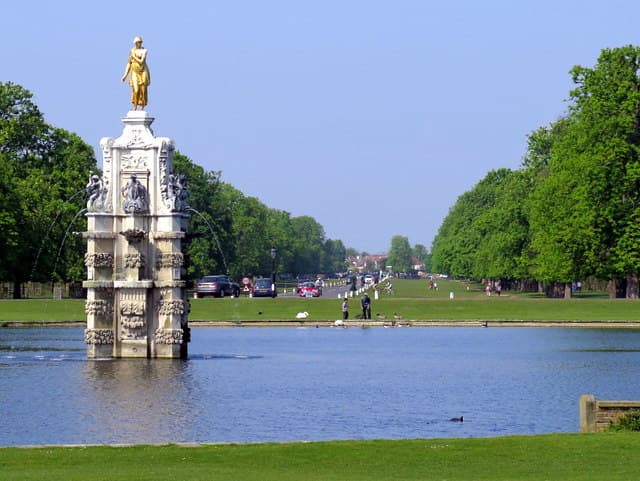
Bushy Park is one of London's largest Royal Parks at 1,099 acres, with long open avenues that are ideal for distance recall work and distraction-proofing at scale. The critical thing to know about Bushy Park for training purposes is that dogs must be kept on leads from 1 May to 31 July each year due to the deer birthing season. Rather than a limitation, experienced local trainers treat this period as an opportunity to focus on on-lead manners and loose-lead walking before the park reopens for off-lead work. Richmond Park offers vast heathland and wooded copses that suit intermediate off-lead work and distraction training, with the same compulsory on-lead period applying from May to July. Dogs must be kept away from deer at all times outside this period, and chasing deer can result in prosecution. Canbury Gardens provides a completely different environment: a riverside strip along the Thames with open lawns, good footfall and a dog-friendly pub in The Boaters Inn, making it well-suited to socialisation work and loose-lead practice on flat, accessible paths. Surbiton Recreation Ground is a popular morning spot for basic obedience and off-lead exercise in one of the borough's denser residential areas, while Coombe Wood offers quiet woodland paths near the Coombe estate that work well for distraction and scent work with larger gundog breeds in a low-traffic setting.
Local requirements and standards
Kingston operates under two separate sets of rules depending on which green space you are using, and it is worth understanding both. For council-managed parks, Kingston's Dog Control Public Spaces Protection Order makes failing to pick up dog faeces an offence carrying an £80 Fixed Penalty Notice, rising to a maximum £1,000 fine on conviction. The PSPO limits any one person to walking a maximum of four dogs at a time in council parks, though licensed professional walkers may apply for a permit to walk up to six at certain sites. Children's play areas, multi-use games areas, formal gardens and sports pitches are designated dog-exclusion zones, and dogs must be kept on leads in car parks and around sports pitch perimeters. Richmond Park and Bushy Park are Royal Parks governed separately by The Royal Parks charity, with their own rules that sit alongside the council PSPO. The compulsory on-lead period from 1 May to 31 July applies across both parks, and The Royal Parks strongly advise against bringing dogs to these parks at all during the deer birthing season if off-lead exercise is the goal. When choosing a trainer, look for ABTC registration as the most important single credential, alongside IMDT or APDT membership and a clear commitment to force-free, reward-based methods. Canine first aid certification is particularly worth confirming for trainers who work near deer in the Royal Parks, where unexpected incidents can occur. Useful questions to ask include which professional body the trainer is registered with and whether the membership can be verified online, whether they ever use punishment or aversive tools, and whether they have specific experience with your breed or the particular challenge you are dealing with.
Neighbourhood insights
Coombe and Kingston Hill represent the borough's highest-investment end for training, with large detached houses, private gardens and affluent families keeping gundogs and retrievers who expect premium one-to-one sessions and thorough behavioural consultations. Direct access to Richmond Park and Coombe Wood means trainers who know these spaces well are especially valued in this part of the borough. Surbiton is Kingston's second distinct hotspot, with dense streets of Victorian terraces and semis, a strong commuter population and a thriving independent cafe culture around Victoria Road that generates consistent demand for well-socialised, cafe-ready dogs. Training needs here blend impulse control and recall work with the practical skills needed for a dog that spends time in busy social environments. The Kingston town centre and Canbury Gardens area has a different profile again, with newer riverside apartment developments and converted Victorian properties housing first-time owners and younger professionals whose puppies need urban-walking skills, loose-lead foundations and crate and separation training from the start.
Seasonal considerations
Summer is the most complex training season in Kingston, and the Royal Parks restrictions are central to that complexity. The compulsory on-lead period in Bushy Park and Richmond Park from 1 May to 31 July displaces many regular off-lead walkers to smaller council parks, which become noticeably busier and make recall and focus work harder than usual. The Kingston riverside and Canbury Gardens also fill with festival-goers and picnickers from June through August, including during the Kingston Riverside Festival, creating excellent but genuinely demanding real-world distraction environments for dogs at intermediate stages of training. Winter shortens the practical window for outdoor sessions significantly, with sunset before 4pm in December pushing demand toward home-visit sessions and indoor group classes. Muddy conditions along the Thames towpaths and through Coombe Wood make loose-lead work and a reliable leave-it cue especially practical skills to develop through autumn and winter, and many trainers report a seasonal uptick in demand for in-home behaviour support as owners spend more time indoors with their dogs.
Areas covered
- Surbiton
- Coombe
- Kingston Hill
- Canbury Gardens
- Kingston Town Centre
- New Malden
- Norbiton